
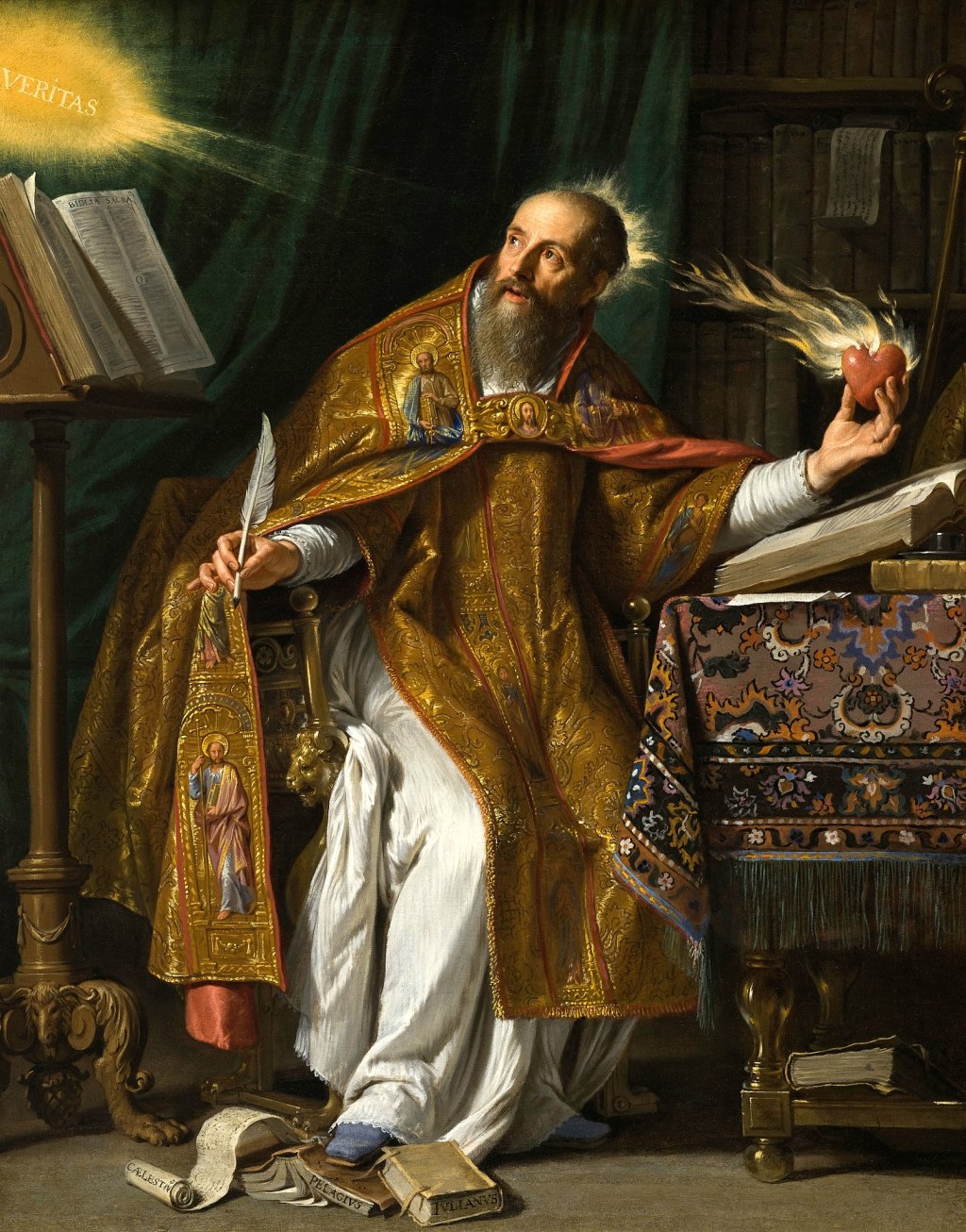
One of the most important questions every Christian must answer is this: To what extent does my will affect my salvation? In other words, what is the power of the will? According to Martin Luther, “For if I do not know what, how far, and how much I can, of my own natural powers, do and effect toward God, it will be alike uncertain and unknown to me what, how far, and how much God can and does effect in me—whereas God works all in all!”[1] Luther famously engaged in a battle over the will against his opponent, Erasmus during the Reformation. Yet, Luther is most certainly not the first to ask and answer such questions. Augustine, the church father whose monastic order Martin Luther was trained in, fought a major battle one thousand years earlier over the nature of the will and grace that sometimes seems forgotten in a modern evangelicalism that often holds semi-Pelagian assumptions or related views.
Pelagius and the Semi-Pelagians
To fully understand semi-Pelagianism, the teachings and ideas of the British monk, Pelagius, must be demonstrated in order to see how later thinkers modified his teachings to provide a stronger case for human autonomy and initiative in salvation. The available writings of Pelagius are few in number and sometimes only exist in fragmentary form. This is because much of his work was destroyed after he was declared a heretic at multiple councils, including the Council of Carthage in 418 AD. However, we still can access major contributions to this battle through a letter written to a family friend, Demetrias, and his commentaries on the Pauline epistles.
The Views of Pelagius
The Letter to Demetrias serves as a valuable contribution to our understanding of his teachings because it is not necessarily a polemical work. It was written as an exhortation to a young Roman noblewoman to live a life of holiness. Thus, we see Pelagius naturally teaching on the will without reference to opponents. In his letter, he establishes the goodness of God’s creation, and how man was given agency over all creation. He quotes Sirach 15:14 to draw his conclusion, “the Lord of Justice wished man to be free to act and not under compulsion; it was for this reason that ‘he left him free to make his own decisions’ and set before him life and death, good and evil, and he shall be given whatever pleases him.”[2] His doctrine of human autonomy is rooted in the uniqueness of God’s creation of mankind. It is an innate dignity for mankind to be free to choose good and evil, and to recognize and serve God “by means of his intelligence and mental vigour.”[3] Thus, Pelagius asserts that human will is truly free in its agency to choose moral actions, as well as serving or not serving God.
His commentary on the book of Romans showcases his denial of original sin. In his comments on Romans 5:12, he states, “But here he says all are dead because in a multitude of sinners no exception is made for a few righteous.”[4] For Pelagius, Paul speaks generally but not absolutely. He believed that most people have sinned and are considered dead, but people like Abraham, Isaac, and Jacob lived righteously, so they were not considered dead. Therefore, there is a natural ability to choose despite most choosing evil. His comment on Romans 7:25 claims, “Was Paul then not yet set free by the grace of God? This shows that [the apostle] is speaking in the person of someone else.”[5] To him, Paul’s struggle with sin and inability is not his own, but of someone who has not received grace. Yet, even this graceless person desires to follow the law and serve God, but his choices have led him to this compulsion to sin.
The key text that highlights man’s choice as inviolable is found in his comment on Romans 8:29. Here he describes God’s foreknowledge as, “The purpose according to which he planned to save by faith alone those whom he had foreknown would believe.”[6] He cements this further by saying, “Now a call gathers together those who are willing, not those who are unwilling.”[7] The implication here is that God’s choice and calling us contingent on our willingness and choice.
In summary, we can describe Pelagius’s beliefs concerning the will and grace in this way: the will is capable of all good choices, and the grace of God is helpful but not necessary. God’s foreknowledge and calling is contingent on the future faith and choice of believers.
The Views of the Semi-Pelagians
Despite how well-known Pelagius is, his beliefs on the will and grace were formally condemned in two separate councils. However, his ideas served as theological starting points for later theologians as they significantly changed but strengthened the Pelagian formula. John Cassian is a foundational figure in popular semi-Pelagian thought, and his monastic text Conferences contains many passages that show his views on the will and grace. There is very little semi-Pelagian literature widely available for access today in English, and this makes sense considering how it is a reaction to Augustine’s doctrine of predestination, not a new school of theology. The semi-Pelagians did not write large polemical works on the subject, and there was little controversy considering that “they were admirers and followers of the Augustinian teaching in every issue of doctrine except the issues relating to predestination.”[8] Even Augustine himself believed “that those who were disagreeing with him on predestination were ‘brothers of ours,’ whose acceptance of the doctrines of original sin and grace ‘abundantly distinguishes them from the errors of the Pelagians.’”[9] However, we can use Cassian’s Conferences as well as Vincent of Lérins’s ‘Commonitorium to get the general picture of semi-Pelagian theology.
Cassian changes the Pelagian formula fundamentally by stating, “men always have need of God’s help, and that human weakness cannot accomplish anything that has to do with salvation by itself alone.”[10] Grace is not just helpful, but needed. However, Cassian also states that “And when He sees in us some beginnings of a good will, He at once enlightens it and strengthens it and urges it on towards salvation, increasing that which He Himself implanted or which He sees to have arisen from our own efforts.”[11] God does not always initiate salvation in men. To Cassian, sometimes God puts a good will in our hearts, other times it comes by our own efforts.
His summary argument follows: “For we should not hold that God made man such that he can never will or be capable of what is good: or else He has not granted him a free will, if He has suffered him only to will or be capable of evil, but neither to will or be capable of what is good of himself.”[12] Thus, Cassian’s theology can be described as an intentionally vague middle-ground between classic Pelagian favor to human will and Augustine’s stronger view of grace. The vagueness seems intentional simply because Cassian avoids answering absolutely to questions surrounding the chronology of faith and grace. This is a departure from Pelagius, but at the same time Cassian preserves Pelagian’s agency of mankind to choose good or evil. He actively avoids any Augustinian understanding of predestination, instead pointing to God seeing from “afar”[13] the spark of good within man then fostering it, suggesting that God predestines based on future faith. This is similar to Pelagian declarations on predestination, but Cassian avoids clear statements in regard to predestination. Though he is vague about the beginnings of our salvation, Cassian is clear when it comes to its completion: “But who can easily see how it is that the completion of our salvation is assigned to our own will.”[14] The perseverance of the saints rests in their will to continue and endure in salvation.
Semi-Pelagian theology is not merely disagreement on doctrine however, but its concern is also methodological. It is partly born out of a fear of Augustinians casting off the traditions and authority of the church. Vincent of Lérins in his Commonitorium explicitly calls out heresies of the past, pointing to their departure from past teachings and decrees of the church. In this work, he never mentions Augustine by name, but he certainly is reflecting the concerns of the broader movement of semi-Pelagianism against a formulation of grace that does not significantly include the power of human will and operation. He warns that people who believe this, “without any labour, without any effort, without any industry, even though they neither ask, nor seek, nor knock, have such a dispensation from God, that, borne up by angel hands, that is, preserved by the protection of angels it is impossible they should ever dash their feet against a stone, that is, that they should ever be offended.”[15]
The underlying fear of semi-Pelagians like Vincent is that a sect of Christianity that believes in a special grace of God would see works and effort as unnecessary. Thus, Vincent calls the church back to antiquity and warns against the doctrine of special grace as a novel doctrine that leads to inactivity. This fear of inactivity results in Vincent accusing them of heathenism. Pelikan describes it as he quotes from Objectiones Vincentianae, “the Augustinian doctrine appeared to be epitomized in the thesis that ‘by God’s predestination men are compelled to sin and driven to death by a sort of fatal necessity.’”[16]
In totality, we can describe semi-Pelagianism as a rejection of the Pelagian denial of grace and original sin, but also a rejection of Augustine’s doctrine of predestinating grace. God sometimes initiates salvation, but sometimes man initiates salvation; in either case, God’s grace towards humanity is required. Man is by nature sinful, but not so sinful that he is unable to strive after God. God predestines according to the future faith he sees in people, and salvation is completed by the endurance and will of individual saints. Semi-Pelagian theology is driven by a desire to preserve past church tradition, and a pastoral concern over moral licentiousness. As a result, semi-Pelagianism emphasizes human agency and individual moral responsibility.
The Views of Augustine
Although the semi-Pelagians present genuine pastoral concerns, their ambiguity on the workings of grace and salvation are hard to harmonize with Scripture’s insistence that God is the agent of salvation and his will determines all outcomes. Augustine’s doctrine of grace stands in contrast to this ambiguity, making clear statements concerning the will of man, the predestinating work of God, and the initiating work of grace in salvation. What is the assurance of Christians whose salvation depends on their initiative and endurance? If God’s predestinating work depends on future faith, then does that make God contingent on humanity? It is these questions that Augustine answers not on the basis of tradition or councils, but on the clear teachings of Scripture. His formulation on the will and grace can be traced through three major treatises: On the Spirit and the Letter (412 AD), On Grace and Free Will (426 AD), and On the Predestination of the Saints (429 AD).
On the Spirit and the Letter
Augustine’s On the Spirit and the Letter is addressed to a believer close to him named Marcellinus, and it directly confronts the presupposition that the mere existence of the Law and commands in Scripture imply the capacity and ability to carry them out fully. His essential statement is that “a man’s free will, indeed, avails for nothing except to sin,” and instead teaches that the “teaching which brings to us the command to live in chastity and righteousness is the letter that kills, unless accompanied with the spirit that gives life”[17] based on 2 Corinthians 3:6. In other words, God gives us commands, but we are unable to obey them unless the Spirit gives us a holy desire to. The Law is a means “to alarm the unrighteous” and cause them to flee in faith to receive God’s grace.[18] Thus, no one can attain to “the precepts which the law of works (Rom. 3:27) commanded, except to be assisted by the grace of God.”[19]
Where Cassian conceded that sometimes grace initiates salvation, and sometimes man initiates it, Augustine decisively states, “He does not, indeed, extend His mercy to them because they know Him, but that they may know Him.”[20] He places God as the catalyst for salvation, leaving no ambiguity in the beginnings of salvation, and at the same time providing certainty in our salvation because it is not contingent on us but on the Spirit.
In Romans 8, after Paul recounts his own personal struggle with sin, he contrasts the works and desires of the flesh with the works and desires of the Spirit. Here, Paul speaks declaratively: “For the mind that is set on the flesh is hostile to God, for it does not submit to God’s law; indeed, it cannot. Those who are in the flesh cannot please God” (Rom 8:7–8 ESV).[21] In other words, “apart from the enabling of the Holy Spirit, there is no ability to do the will of God.”[22] Here, there is never a command to kill sin apart from the Spirit. Instead, Paul says, “but if by the Spirit you put to death the deeds of the body, you will live” (Rom 8:13). It is by the Spirit and His leading that we kill our evil works. This does not lead us to inactivity, instead, it gives assurance and certainty to our activity.
On Grace and Free Will
If then the will does not initiate salvation, and if it does not obey the Law outside of the Spirit’s promptings, is there any room left for the human will and responsibility? Firstly, Augustine declares that “they labour with all their might to show that God’s grace is given according to our merits,” to which he concludes “that grace is not grace.”[23] Grace is an undeserved gift, not a wage. However, he clearly affirms that “there is in a man a free choice of will” in order to attain rewards in heaven, but this is after God’s intervening act of grace in their hearts.[24] Before God’s grace, the will is free to choose, but he writes in another work that “in doing evil every one is free from righteousness and a servant of sin.”[25] We can synthesize Augustine’s doctrine of the will as being free to choose but not free in its desire. God must intervene with his grace in order for us to become truly free. Therefore, Augustine argues for a free will that has been made free, not a will that was born free.
In John 8, Jesus declares to the believing Jews, “If you abide in my word, you are truly my disciples, and you will know the truth, and the truth will set you free” (John 8:31–32). This freedom in Christ is no abstract concept of puffed-up speech; it is a freedom that we are in desperate need of. For Jesus tells us “everyone who practices sin is a slave to sin.The slave does not remain in the house forever; the son remains forever.So if the Son sets you free, you will be free indeed” (John 8:34–36). This practice of sin is not for a special few sinners, but D. A. Carson observes “the Greek is literally ‘the one who does sin.’”[26] Jesus frees our wills from its bondage to sin.
The clearest statement then of the role of the will in Christ is found in Philippians 2. There, it says: “Therefore, my beloved, as you have always obeyed, so now, not only as in my presence but much more in my absence, work out your own salvation with fear and trembling, for it is God who works in you, both to will and to work for his good pleasure” (Phil 2:12–13). Paul here treats the will as truly being active but God’s will as also being active in ours. God works in us, yet, we are called to work. Thus, we can conclude that our newly freed will is a means that God has ordained to achieve the end. We strive for obedience in Christ, and we rest in the truth that God works out obedience in us. We are left with nothing to boast about and everything to rest assured in.
On the Predestination of the Saints
Augustine rejects the Pelagian idea that God foresees a future faith within us and bases his predestinating work upon that. Instead, he cites Romans 11:35 and asks, “from whom, then, is that very beginning of our faith if not from Him?”[27] If faith is something that originates within us, then God’s grace is truly a wage because faith then becomes a merit that demands one. The reasoning for God’s selective grace not being given to us is, “His ways are unsearchable. Therefore, the mercy by which He freely delivers, and the truth by which He righteously judges, are equally unsearchable.”[28] Yet, this is not a concession from a weakness in his theology, it’s following the principles of Scriptures. He consoles his readers by saying that “this gift is given to some, while to some it is not given. But why it is not given to all ought not to disturb the believer”[29], because God would be just to condemn all humanity. Therefore, it is an abundant sign of his goodness that he gives faith to many.
In Romans 9:11–16, Paul wrestles with the idea that many of his Jewish brethren have rejected the gospel, and rhetorically asks if the purposes of God have failed. In his answer, he cites the story of Jacob and Esau’s birth. The declaration to Rebekah in this birth story that, “The older will serve the younger” (Rom 9:12), was not based on a foreseen merit in Jacob over Esau. An important “circumstantial clause in the form of a genitive absolute”[30] preceding the declaration describes its reasoning: “though they were not yet born and had done nothing either good or bad—in order that God’s purpose of election might continue” (Rom 9:11). God’s choice of Jacob to rule over his brother was not rooted in merit or foreseen faith, it was according to God’s own purposes. This passage clearly shows that Augustine’s doctrine of predestination was not a novelty, but a certain teaching of Paul. The semi-Pelagians struggle to account for Romans 9 because Paul explicitly grounds God’s election in his own purposes, saying, “So then it depends not on human will or exertion, but on God, who has mercy” (Rom 9:16).
Objections to Augustinian Grace
The strongest objection to the Augustinian doctrine of grace is in the logical conclusions some have drawn. As Vincent pointed out earlier, for anyone who holds to a doctrine of special grace, the natural outcome is that men will neglect works and striving after God. In other words, if God determines the outcome, doesn’t that make our will and works meaningless? Firstly, Paul anticipates people using their freedom as opportunity to neglect works. He says, “For you were called to freedom, brothers. Only do not use your freedom as an opportunity for the flesh, but through love serve one another” (Gal 5:13). Our freedom is meant to be an occasion to practice love to one another. Finally, God’s choosing and purposing is meant to achieve the end of holiness in us. For Paul says in Ephesians 1:4, “even as he chose us in him before the foundation of the world, that we should be holy and blameless before him” (Eph 1:4). We were predestined, not for moral laxity, but for a holy life. It seems then that Scripture uses the promises of God’s active work in us as assurances and power for the work of our wills in striving after holiness.
The second strongest objection to Augustine’s theology of grace is the question of God’s morality in ordaining all things. If God only chooses some, and not others for salvation, doesn’t that make God unjust? Doesn’t that diminish God’s character of love and mercy? Cassian poses this question when he asks, “For if He wills not that one of His little ones should perish, how can we imagine without grievous blasphemy that He does not generally will all men, but only some instead of all to be saved?”[31] Firstly, Paul makes very clear in Romans, “all have sinned and fall short of the glory of God” (Rom 3:23). Therefore, we are all equally guilty of sin. He also tells us that “death spread to all men because all sinned” (Rom 5:12), and thus, we all are deserving of the righteous punishment of God. Would God be unjust if he allowed us all to perish in our sin? By no means. It would have been perfectly just. How then would it be unjust for God to display his mercy by saving some? Secondly, Paul addresses this question directly in Romans 9, “What shall we say then? Is there injustice on God’s part? By no means!For he says to Moses, “I will have mercy on whom I have mercy, and I will have compassion on whom I have compassion” (Rom 9:14–15). We have no right to question God’s justice in his actions, “who are you, O man, to answer back to God?”(Rom 9:20).
Conclusion
The battle between Augustine and the semi-Pelagians was not born out of irrational fears, but the deepest questions about humanity and our destiny. Yet, where the Word of God contradicts man’s philosophy or presuppositions, latter must ultimately submit to the former. Though Pelagius fought what he considered an extreme with his own extreme, John Cassian and Vincent of Lérins did not speak out in polemical crudeness but with a pastoral concern about the outcomes of doctrines held by people like Augustine. However, their concern for holiness unintentionally tried to suppress our greatest assurances for holiness and works. Augustine’s bold stand on the grace of God reminds us that our own pursuit of good and holy works is grounded in the certain decree and workings of God himself. Therefore, we should see every activity of God in our lives not as an assault on our agency, but as sweet encouragements to a holy life lived for the glory of God alone.
[1] Martin Luther, The Bondage of the Will, trans. Edward Thomas Vaughn. (Sanford, FL; Ligonier Ministries, 2025), 22.
[2] B. R Rees, trans., The Letters of Pelagius and his Followers (Rochester, NY: The Boydwell Press, 1991), 38.
[3] Rees, The Letters of Pelagius and his Followers, 37.
[4] Thomas P. Schreck, trans., Pelagius: Commentaries on the Thirteen Epistles of Paul with the Libellus fidei (Mahwah, NJ: The Newman Press, 2022), 72.
[5] Schreck, Pelagius, 81.
[6] Schreck, Pelagius, 87.
[7] Schreck, Pelagius, 87.
[8] Jaroslav Pelikan, The Christian Tradition, vol. 1, The Emergence of the Catholic Tradition (Chicago: The University of Chicago Press, 1971), 318.
[9] Pelikan, The Emergence of the Catholic Tradition, 318.
[10] John Cassian, Conferences 2.13.6, trans. Edgar C. S. Gibson, in A Select Library of the Nicene and Post-Nicene Fathers of the Christian Church, ed. Philip Schaff and Henry Wace, Series 2, Vol. 11, Sulpitius Severus, Vincent of Lerins, John Cassian (New York: The Christian Literature Company, 1894), 425.
[11] Cassian, Conferences 2.13.7 (NPNF11, 425).
[12] Cassian, Conferences 2.13.12 (NPNF11, 428).
[13] Cassian, Conferences 2.13.7 (NPNF11, 425).
[14] Cassian, Conferences 2.13.9 (NPNF11, 426).
[15] Vincent of Lérins, The Commonitory 26.69 (NPNF11, 151).
[16] Pelikan, The Emergence of the Catholic Tradition, 320.
[17] Augustine, A Treatise on the Spirit and the Letter 3.4, trans. Peter Holmes and Robert Wallis, in A Select Library of the Nicene and Post-Nicene Fathers of the Christian Church, ed. Philip Schaff and Henry Wace, Series 2, Vol. 5, St. Augustine’s Anti-Pelagian Works (New York: The Christian Literature Company, 1887), 84–85.
[18] Augustine, A Treatise on the Spirit and the Letter 10.16 (NPNF5, 89).
[19] Augustine, A Treatise on the Spirit and the Letter 10.16 (NPNF5, 90).
[20] Augustine, A Treatise on the Spirit and the Letter 7.11 (NPNF5, 87).
[21] Unless otherwise noted, all Bible quotations come from the ESV.
[22] David G. Peterson, Romans, Evangelical Biblical Theology Commentary (Bellingham, WA: Lexham Press, 2021), 311–312.
[23] Augustine, A Treatise on Grace and Free Will 5.11 (NPNF5, 448).
[24] Augustine, A Treaties on Grace and Free Will 2.2 (NPNF5, 444).
[25] Augustine, A Treatise on Rebuke and Grace 1.2(NPNF5, 472).
[26] D. A. Carson, The Gospel According to John, Pillar New Testament Commentary, (Grand Rapids: Eerdmans, 1991), 350.
[27] Augustine, A Treatise on the Predestination of the Saints 2.4 (NPNF5, 499).
[28] Augustine, A Treatise on the Predestination of the Saints 6.11 (NPNF5, 503).
[29] Augustine, A Treatise on the Predestination of the Saints 8.16 (NPNF5, 506).
[30] Peterson, Romans, 355.
[31] Cassian, Conferences 2.13.7 (NPNF11, 425).


Leave a comment