
Daniel 10:4–11: On the twenty-fourth day of the first month, as I was standing on the bank of the great river (that is, the Tigris) I lifted up my eyes and looked, and behold, a man clothed in linen, with a belt of fine gold from Uphaz around his waist. His body was like beryl, his face like the appearance of lightning, his eyes like flaming torches, his arms and legs like the gleam of burnished bronze, and the sound of his words like the sound of a multitude. And I, Daniel, alone saw the vision, for the men who were with me did not see the vision, but a great trembling fell upon them, and they fled to hide themselves. So I was left alone and saw this great vision, and no strength was left in me. My radiant appearance was fearfully changed, and I retained no strength. Then I heard the sound of his words, and as I heard the sound of his words, I fell on my face in deep sleep with my face to the ground. And behold, a hand touched me and set me trembling on my hands and knees. And he said to me, “O Daniel, man greatly loved, understand the words that I speak to you, and stand upright, for now I have been sent to you.” And when he had spoken this word to me, I stood up trembling.
Today, we will finish chapter one and next time, will look at the letters to the churches.
Rev. 1:9: I, John, your brother and partner in the tribulation and the kingdom and the patient endurance that are in Jesus, was on the island called Patmos on account of the word of God and the testimony of Jesus.
First, we need to note that John is our partner in these contradicting truths: he’s our partner in the tribulation and the kingdom. The experience of being a Christian is both through suffering and triumph. We live in a period of great trials and challenges for the church; yet, the church is the beginnings of God’s kingdom here. What sustains us is the patient endurance that’s in Christ Jesus.
John gives the example here of these things, because he’s here on an island called Patmos. It’s a small, lightly inhabited island off the Greek coast. And he’s here on account of the Word of God.
There are legends that Emperor Domitian tried to boil John alive in a pot of oil, but John survived, and it terrified Domitian so much that he exiled John to the island. But this is probably just a legend, Patmos is a place frequently used by Rome to exile influential people.
Why exile though? Why not execution? Well, that works fine for criminals. But political prisoners and religious figures could be made martyrs, which are very powerful for fueling causes and movements. So, it was better to simply put them on an island by themselves. John is here for this reason. He is there on account of the Word of God, which fits the themes of Revelation of suffering and endurance.
Rev. 1:10–16: I was in the Spirit on the Lord’s day, and I heard behind me a loud voice like a trumpet saying, “Write what you see in a book and send it to the seven churches, to Ephesus and to Smyrna and to Pergamum and to Thyatira and to Sardis and to Philadelphia and to Laodicea.”
Then I turned to see the voice that was speaking to me, and on turning I saw seven golden lampstands, and in the midst of the lampstands one like a son of man, clothed with a long robe and with a golden sash around his chest. The hairs of his head were white, like white wool, like snow. His eyes were like a flame of fire, his feet were like burnished bronze, refined in a furnace, and his voice was like the roar of many waters. In his right hand he held seven stars, from his mouth came a sharp two-edged sword, and his face was like the sun shining in full strength.
It’s the first day of the week, which is called the Lord’s Day in the New Testament (Sunday). And following after the pattern of other prophets, he records that he was in the Spirit. This simply means that the Spirit opened his eyes and ears to see and hear what is about to happen.
And this terrifying voice tells him to write all he sees in a book to these seven churches. Once again, this is a reminder that the whole book is for the churches as a letter. Revelation is not a puzzle to be solved, but encouragement for the churches.
When John turns and beholds the voice that was speaking to him, I think what he saw was incomprehensible. It was obviously Jesus, but not Jesus in a way that John has ever seen. John describes his face like looking at the sun in full strength; you would probably have to shield your eyes. His voice is like the roar of many waters; I imagine the ground shook when he spoke. What’s important to remember is that this passage is not about describing the anatomy of Jesus. Instead, all of these things mentioned are symbolic of who Jesus is.
He saw one like a son of man, which echoes Daniel 7 and this son of man who receives a kingdom from God. His hairs were white and his eyes were like a flame of fire, which shows his purity and wisdom and absolute holiness. The feet of bronze and his voice sounding like roaring waters show to us his strength.
In a sense, many of the truths about who Jesus is are being visualized and communicated to John through this imagery without anyone having to say anything to him. And what is most telling about the power of these truths and what he sees is shown in John’s reaction to Jesus.
Rev. 17-20: When I saw him, I fell at his feet as though dead. But he laid his right hand on me, saying, “Fear not, I am the first and the last, and the living one. I died, and behold I am alive forevermore, and I have the keys of Death and Hades. Write therefore the things that you have seen, those that are and those that are to take place after this. As for the mystery of the seven stars that you saw in my right hand, and the seven golden lampstands, the seven stars are the angels of the seven churches, and the seven lampstands are the seven churches.
He faints and falls at the feet of Jesus. The man who was a close friend of Jesus and walked with him for many years, falls at his feet like a dead man at the sight of him. Yet, Christ lays his hand on him. And I can’t imagine what that would have felt like in that moment. The same hand that healed so many, that holds the seven stars, reaches down and rests on John’s shoulder like a friend would do to comfort another friend. And he says, “Fear not.”
What then should we get from a passage like this? What should come home with us tonight?
And I think that this passage is an invitation for us to behold Jesus Christ. To see him face-to-face, and take in all that he is. Here is the main point then, what we are called to do by this passage mainly:
BEHOLD JESUS AS GLORIOUS.
I think so many times we make being a Christian about so many things and we end up missing the main thing. We read our Bibles, we pray, we go to church, and these are all things we should do, but these aren’t the end of being a Christians, they are means to an end.
And the proper end of being a Christian is to behold Jesus in all his glory.
That Christ and his glory would be the center of our vision and something that we see in the good times and bad times, in the church and outside of it.
I think sometimes we relegate him to just friend or a really nice guy that gets disappointed in us when we mess up. But we’re meant to see him in this glorious state. Because when we do, it puts the blessings and privileges we get in perspective. This all-powerful person we see here is for us, and loves us. There’s something life-changing about that.
We don’t have to go to Patmos to behold Jesus and his glory; those things I mentioned before are means to reaching that end. If you want to behold Jesus, you have to see him in the Word. If you want to behold him, come to him in prayer and speak to him. If you want to behold him, see his work in the lives of those around you in a church.
I’ve told you before this principle: we become what we behold. Whoever you focus on the most, whoever you find yourself around a lot, whatever things you put the most time into, those things and people shape you the most. I hope that we all want to become more like Christ, and the road to reaching that is beholding Christ as glorious. His glory transforms us.
How do you see Jesus? What is he to you?
Branching off this idea of the glory of Christ, I want to very briefly mention a couple smaller ways we can behold Christ that serve that main function of beholding him as glorious. These all contribute to that fact.
And the first way is this:
1. Behold him as the holy God.
Rev. 1:13-14: …and in the midst of the lampstands one like a son of man, clothed with a long robe and with a golden sash around his chest. The hairs of his head were white, like white wool, like snow. His eyes were like a flame of fire,
Christ is not just a really nice guy, or someone who loves us, or someone who died for us. He’s our Holy God. Remember, to be holy is to be set apart and pure. This imagery is directly out of Daniel 7, and it’s imagery associated with God himself.
Part of Christ’s glory is that he existed before time. He’s utterly pure, his eyes of fire tell us nothing is hidden from his holiness. He sees everything. We can’t hide anything from him. There’s only one characteristic of God that is repeated three times in a row to show its significance, and it’s his holiness when the angels say: HOLY HOLY HOLY! (Isa. 6).
I think that we’ve many times made Jesus into something very casual. We treat him like a buddy, or someone who just wants us to be happy. And while he does love us and is near to us, there’s a balance to that. Holiness should produce in us reverence or respect. If you feel like you’ve been complacent and content in your sin, then maybe you need to behold Jesus as the holy God. This image drives us to change our ways and repent before him. We need this.
2. Behold him as the righteous judge.
Rev. 1:16: In his right hand he held seven stars, from his mouth came a sharp two-edged sword, and his face was like the sun shining in full strength.
Why is there a sword coming out of his mouth? The sword in the Bible is often symbolic for judgement. Yet, why is it coming out his mouth? Because he is the Judge whose words are judgement (Heb. 4:12-13). His face is like the sun in full strength, it exposes all darkness and no one can stand on their own before it.
Beholding him as a righteous judge is a comfort and warning at the same time. It’s a comfort for those who see the injustice, evil, and cruelty in the world; we get to trust and know that it isn’t going unseen and unaccounted for. Christ is coming and he will make things right.
Yet, it’s also a warning to those who live a secret life; who put on the show for your friends and parents and church people, but in secret you live completely differently. We don’t see you, but Jesus the righteous judge sees you. You can’t hide from him, these eyes that are like a flame of fire see through it all. Yet, even for you, Christ offers his blood as a payment and sacrifice, and something that covers us to where we can stand on the day when he comes to judge, if we will receive it in faith.
3. Behold him as near to us.
Rev. 1:17: When I saw him, I fell at his feet as though dead. But he laid his right hand on me, saying, “Fear not, I am the first and the last,
This is an emotional center of this passage and it puts into perspective the other things we’ve mentioned. Christ walks with us. And this is made clear in the other imagery.
Rev. 1:12-13: Then I turned to see the voice that was speaking to me, and on turning I saw seven golden lampstands, and in the midst of the lampstands one like a son of man, clothed with a long robe and with a golden sash around his chest.
It says Jesus was standing in the midst of the seven lampstands, and held seven stars in his hands. What are these things? He gives us a description. The Lampstands are the seven churches. The Stars are the angels of the seven churches. The Greek word for there for angel is messenger, which could be interpreted as the pastors of the churches, or it could actually be angels that are assigned to watch over the churches. In either case, Jesus is walking amidst the churches and is holding them in his hand.
The Lampstands are significant because a prominent structure in the Temple of the OT. Very much some priestly language going on here about Jesus. But what’s important here is that Jesus has never left the churches. He is with us. He is not distant. John is in exile, yet, the Romans sending him to this island could not separate him from Jesus. What makes you think the things in your life will?
No, Christ is with us in the good and the bad, in our highs and lows. You are going to go through some serious challenges and lows in your life. But in those times, you need to stop and sit and feel Christ’s hand on you, and hear his words: “fear not.” It seems like it’s been in my lowest moments that Jesus has met me the most. What an encouragement for us, especially for these guys going through intense trials.
4. Behold him as the conqueror of death.
Rev. 1:17-18: When I saw him, I fell at his feet as though dead. But he laid his right hand on me, saying, “Fear not, I am the first and the last, and the living one. I died, and behold I am alive forevermore, and I have the keys of Death and Hades.
Hades is a Greek word for death. In the ancient world, keys were a symbol of authority and control. If you have the keys you have access. Jesus didn’t merely come back from death in the resurrection, he conquered it.
That was the threat of the powers around these first century Christians, yet, Christ reminds them that death doesn’t have the final word over us, and is not the final part of the story.
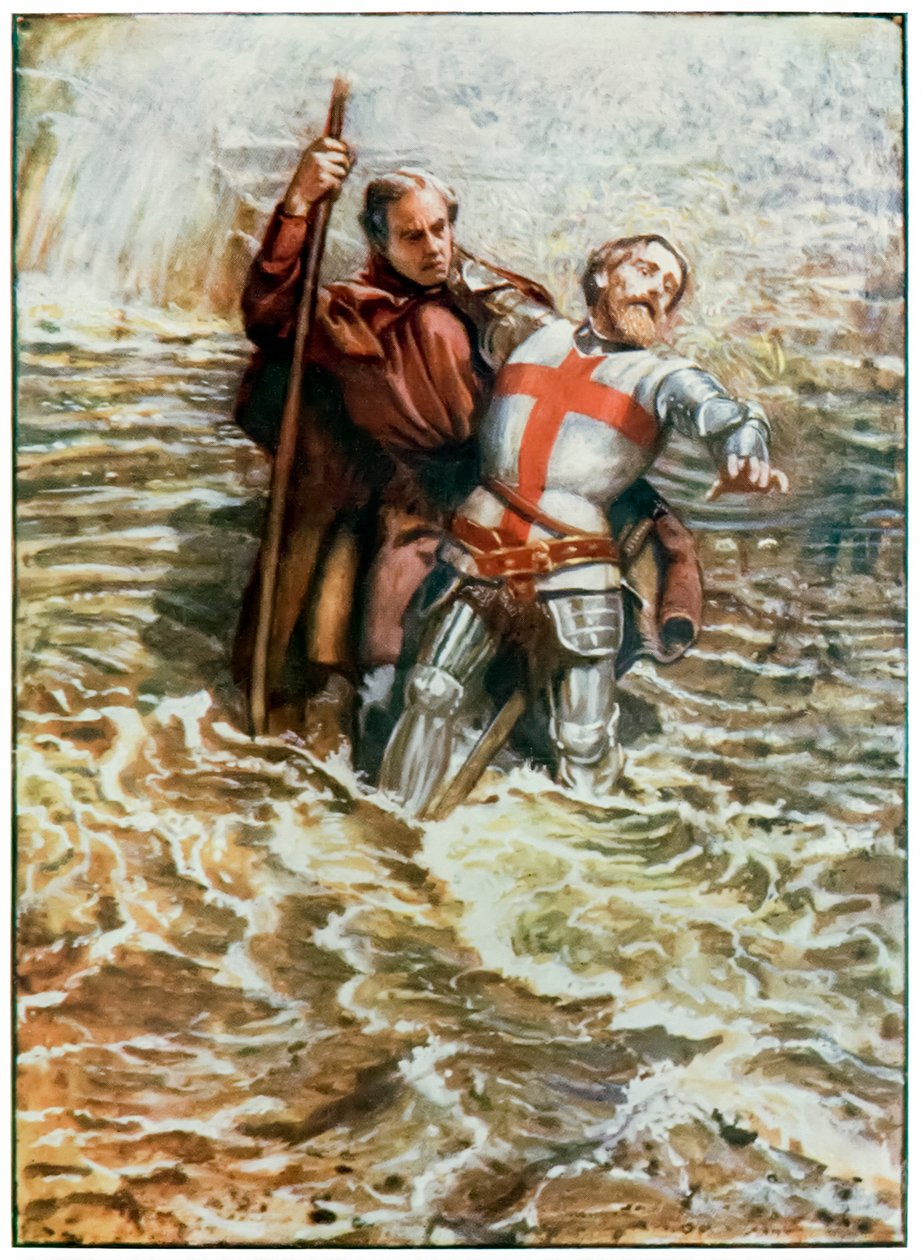
There’s a great book called the Pilgrim’s Progress by John Bunyan. And it’s an allegory about the Christian life. And the allegory revolves around a man named Christian who is traveling to this celestial city where the king lives and is calling him to.
But as Christian and his friend named Hopeful finally make it there, there’s one final obstacle.
“So, I saw in my dream that they went on together until they came in sight of the gate. Between them and the gate was a river, but there was no bridge crossing over it, and the river was very deep. The sight of this river greatly stunned the pilgrims, but the men who walked with them said, ‘You must go through the river or you cannot come to the gate.’”
And they are pretty distressed about this, but these angels that were with them tell them:
“You shall find the water deeper or shallower as you believe in the King of the city.”
As they cross, Christian becomes very worried and tells himself that surely if the king loved him he would just rescue him out of it, but his sin has caused him to be abandoned.
But he catches a glimpse of the king through the waters, and he shouts out,
“I see him! And he tells me, When you pass through the waters, I will be with you; and through the rivers, they will not overflow you,”
Which is an exact quote of Isaiah 43:2. They make it to the shore, and it says,
“they left their mortal garments behind them in the river, for even though they went into the river with them, they came out without them.”
And they walk up the hill to the city at ease. Arriving at the city, the angels tell them,
“You are going now to the paradise of God, in which you shall see the Tree of Life, and eat of its never-fading fruits. When you arrive there you shall be given white robes, and every day your walk and talk shall be with the King, even for all the days of eternity.”
John Bunyan paints this wonderful picture of the end of our lives, and death is symbolized by this river that must be cross through. Yet, it was when Christian beheld Jesus that the fears and worries of crossing that river vanished, and he was reminded that Christ is with us, even in the midst of deep waters.
We all will die one day. As young people we don’t think of this, but even young people die. But when we cross that river, it won’t be alone. Will you behold Christ and cross with joy? Or will you look at the waters and its depths and sink?
Today, the call for us all is to behold Christ in his glory. His glory as a holy God, his glory as a righteous judge, his glory as the one who’s near to us, and his glory as the conqueror of death. I pray that everyday, you’d behold him and be transformed by that image.


Leave a comment